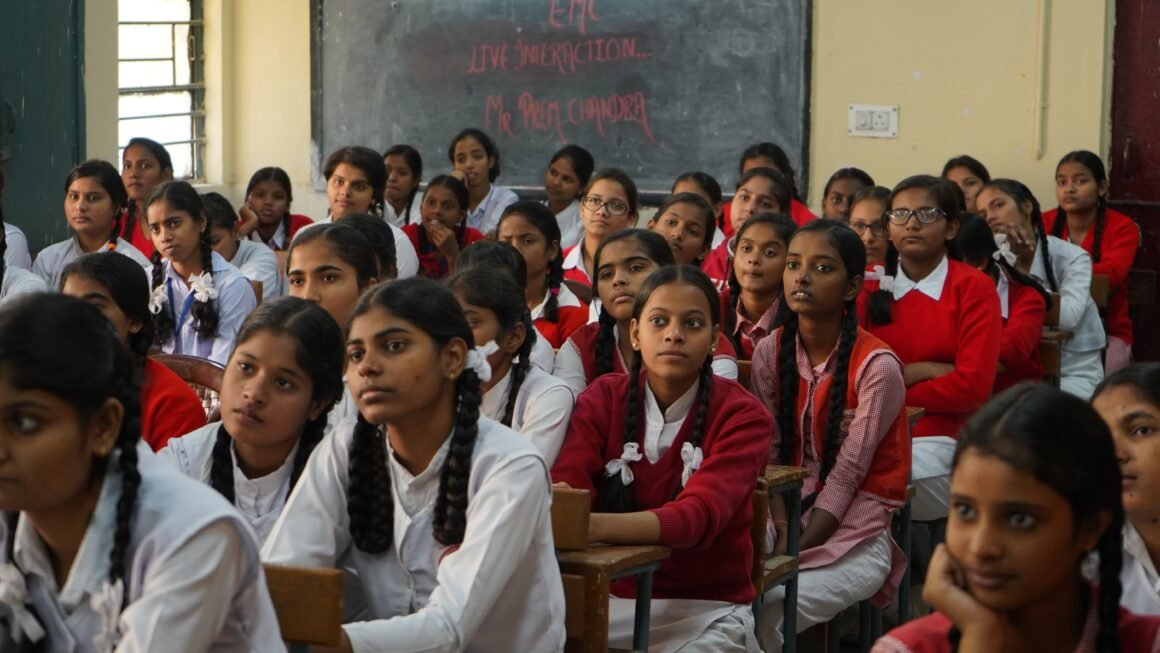
Do you remember what it was like when you were in 10th grade – How did you feel? What was important for you? What concerned you? What were your fears? Your hopes and wishes?
As a 10th grader, I was afraid of scoring below 80%, I was concerned I wouldn’t make my parents proud. I was confused about what I wanted to do after 10th. I knew arts and commerce were not an option, because there was an unsaid expectation that I’d pick science. And given that I didn’t have the stomach for engineering, medicine it was. Cutting a long story short, I took physics, chemistry, mathematics and biology. It turns out what science is until 10th, it does not prepare you for the reality of higher secondary education. I dropped a year, having realised medicine is not for me. I joined Arts Stream with an English major which I enjoyed but did not see myself making a career out of it. I am now working in social development and fortunately, I love it, I can see myself doing this for a long time.
Sometimes I wonder, what if? What if I’d chosen arts without dropping a year. Chosen social sciences from the very beginning. . . the anxiety of dropping the year, the burden of disappointing myself and my parents, the confusion, the fear, the helplessness – all of it could be avoided. Well that is not to say I would change anything, I am where I am because of my experiences and undoing anything would mean undoing what all I learnt from it. After all, in the end it turned out just fine for me. So why change anything? However, that may not be the case for many of the 10th graders. Making an informed choice impacts our life outcomes substantially.
Our quality of life is largely determined by the kind of job we’re working in, the environment we’re in, and the support systems we have. Ability to deal with any life crisis, to lead a stable, stress free life – one of the major contributors to this, in addition to our support systems is career.
10th standard is an important trajectory point for progression in life in the context of career decision making. Until this point education is generalized, with the child studying all topics. Post 10th the child has to choose from a broad spectrum which will influence future specializations. Out of the several progression routes children can take post 10th, 3 major ones are – Progression to higher secondary education, progression to training/apprenticeship, progression to job. These choices have a long term effect on our lives – think about your life, was making that choice easy?
According to an independent study, 93% of underprivileged children are aware of only 7 career options. Many opt for higher studies because the current field has limited scope. Many change choices as the initial choice was not informed. And some get it right.
Lets contextualize this, focusing on children in need of care and protection. Children who have gone through adverse childhood experiences, who likely have low exposure levels.
In 2015 a study was done with about 1700 children across 43 child care institutions in India, to analyse the trends in relation with work readiness and career choices of children from disadvantaged backgrounds. The age group of children interviewed ranged between 11 to 17 years. Some of the findings of the study are :
- Science is the most prevalent theme, followed by arts and commerce at almost the same level in terms of number of children who preferred them, while commerce was second in terms of prevalence if looked at from an institutional standpoint. Arts was the preferred stream in female only homes. Most children are aware of 7-8 career options
- Around 27% of children lacked motivation or interest in any goals. (To learn more about how to motivate children click here) Around 10% of the children mentioned career interests in professions like Chef, Singer, Fine Arts, Sports person, PT instructor and Law.
- Favorite subjects of the child – A 50-50 divide between Languages & Mathematics and Science for almost all institutions. Few children also included other subjects like history, social studies, computers, drawing etc. Reasons for being favorite was mostly because the child felt that the subject was easy to understand, interesting or was his/her mother tongue. Only about 1% of the children linked it to their future career interest.
To understand the inference we can draw from the information, I’d like to talk a bit about my journey of working with children in need of care and protection.
- One of the children that I worked with while I was still in college, was living in a child care institution. She had entered the said institution due to a family breakdown. I asked her what you want to do when you grow up. She answered I want to be a lawyer. She told me her father was in jail and she wanted to be a lawyer so she could fight legal cases. Her career aspiration was based on a singular factor.
- Once, after an industry visit we’d organised for children to go to a printing house where they interacted with journalists and learnt about the process of printing newspapers – a child saw a new paper printed in the regional language and came up and said, I thought you couldn’t be a journalist if you didn’t know English. Imagine her surprise at realizing that she had more options that she’d initially thought of.
- A third child wanted to be in the police services because another senior from the institution had recently joined the forces. She’d only been exposed to a few careers.
The reason I spoke about those 3 examples is to highlight the fact that the environmental factors at play for such children that affect decision making are significantly different from ours. Considering the study and observations of people who have worked with such children, we can draw the flowing insights :
- Children are exposed to limited career options. They have limited access to and knowledge of real world opportunities.
- Children mostly follow the stream of choice that is prevalent/popular in the institution by history.
- Children’s choice sources are influenced by peers leaving institutions, parents and shelter authorities.
- Children who are aware of their preferred choice don’t know how to get there. This is further validated by an impact assessment done for Lifeskills program in Bengaluru in 2018. Over 55% of children do not know the means to achieve their dream.
The question is : How do we empower children to make informed career decisions?
Decision making is a cognitive skill. It is the thought process of selecting a logical choice from the available options to arrive at a particular result. When trying to make a good decision a person must weigh the positives and negatives of each option and consider all the alternatives. For effective decision making a person must be able to predict the outcome of each option as well and based on all these items, determine which option is the best for that particular situation.
There are 4 key steps involved in decision making.
- Step 1 : Identifying when a decision needs to be made
- Step 2 : Thinking of possible options
- Step 3 : Evaluating the options
- Step 4 : Choosing strategies for making the decision and reviewing how it works.
Children learn skills for making good decisions gradually. Even young children regularly choose how they will behave, which toys or games they would like to play with, which books they would like to have read to them, or which television shows they would like to watch. As they get older children make bigger decisions that involve their family, friends and school. The decisions children make affect their well-being, relationships and success in life.
Children’s decision making is strongly influenced by the expectations and values they learn from those around them. This occurs through –
- Observing others (particularly those close to them),
- Hearing about and discussing situations / rationale and,
- Having opportunities to make decisions and experience their consequences.
| Age | 10 – 13 year old | 14 – 16 year old |
| Grade | 5 – 7 Grade | 9 – 10 Grade |
| Developmental stage | Younger children [infancy to pre-adolescent] are more likely to:– focus on one aspect of a situation- focus on their own position- look for immediate benefits- want things now- act without thinking first- make simple distinctions between good/bad, right/wrong- make decisions based on a whim. | As they develop, children [adolescent] are able to:– see things from different angles- see other people’s points of view- think ahead and plan- focus on longer range goals- consider consequences- apply more complex concepts to their own thinking- use reasoned strategies for making decisions |
Career decision making is an interplay between a child’s environment and developmental stages. Career development behaviours are affected by three social cognitive processes – self-efficacy beliefs, outcome expectations and career goals and intentions which interplay with ethnicity, culture, gender, socio-economic status, social support, and any perceived barriers to shape a person’s educational and career trajectories.
Keeping the above in mind, we can say that children will be able to make informed decisions if
- They are exposed to different careers. This can be done through experiential workshops led by experts, industry visits, conversations with people from different fields. This is especially important today when the career options available for children are far more varied than they were ever before
- They understand the real world application of the subjects they study. This can be done by focusing on applied learning – that is helping the child understand the application of a subject. For instance, something as simple as knowing that geometry is connected with architecture. Bringing the real world context to education. Focusing on experiential learning, and closing the loop of learning for the child. Using problem solving approach, making the class interactive, using activity based learning,
- They have the opportunity to practice decision making and have support for autonomy. Individual’s abilities for making decisions develop with practice , experience and maturity. The individual needs autonomy to make decisions. For instance, if adults make all the decisions for children or continually override their decisions, children cannot develop a sense of autonomy that is necessary for them to make wise decisions for themselves.
- They are given responsibility and helped in building a sense of ownership. Individual decision making skills will improve on taking ownership or responsibility. For example – Getting children to be responsible for feeding pets, looking after their sports gear, managing their pocket money, or regularly doing a particular household chore gives children opportunities to make decisions and demonstrate responsible behavior.
- They are supported in planning for the future. Helping them make a plan for the future. Through goal setting – short term and long term. For instance sessions like bull’s eye at dream camps. Other ways include career counselling. Giving them an opportunity to work on tasks.
- They have the opportunity to build social skills and life skills critical for work readiness. These skills are : Interpersonal skills (communication, social skills), Personal skills (motivation, confidence, ability to deal with emotions) & Operational skills (problem solving)
One thing to keep in mind for all the above is, functional skills like self awareness of their own strengths and challenges and foundational academic readiness are hygiene factors critical for career progression.
Further, the above article only covers one aspect of empowering children. There are several factors like stakeholder engagement, having trusted adults around them that need due attention as well.
We can help children make informed career decisions; we just need to ensure that opportunity is guided by awareness, exposure, and access—not limited by circumstance.
References
https://cdnbbsr.s3waas.gov.in/s34c144c47ecba6f8318128703ca9e2601/uploads/2020/10/2020102082.pdf
https://www.makeadiff.in/model
https://csa.org.in/public/uploads/research_papers/b552f7bf3ca0d4f2d0fed3b131d698f4.pdf